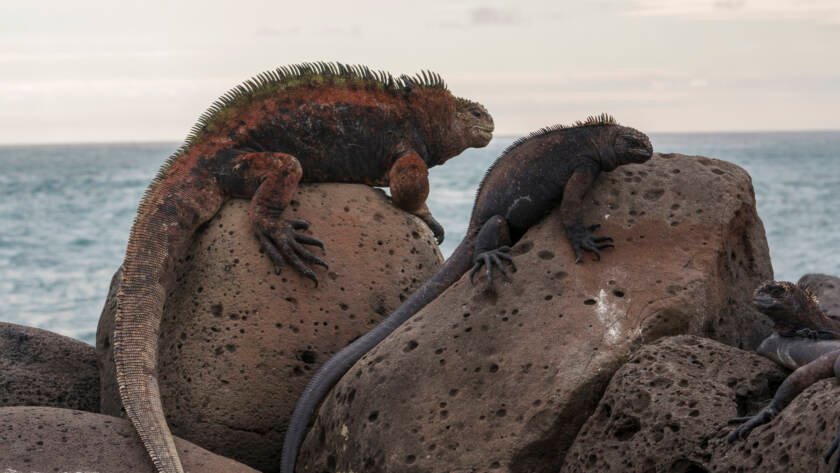


Amblyrhynchus cristatus
One of the most fascinating examples of evolutionary adaptation in the world. It is the only lizard on earth capable of marine foraging.
It possesses specialized exocrine glands located above the eyes, connected to the nasal passages. Because the animals ingest large quantities of seawater, these glands concentrate excess salt and expel it through forceful sneezing — frequently leaving a white salt crust on top of the head.
As ectotherms, marine iguanas are entirely dependent on external heat sources for thermoregulation. After diving in waters as cold as 15°C, they must flatten their bodies against black lava rocks to maximize heat absorption.
One of the most remarkable scientific discoveries concerns the species’ response to El Niño (ENSO) events. Marine iguanas can reduce their total body length by up to 20% — actively reabsorbing their own bone matrix. Once food availability returns, individuals recover their original body size.