

 “I never thought environmental conservation had anything to do with me. Now I know that protecting the sea is also protecting our future.”
— Dana, Blue Guardian, San Cristóbal
Introduction
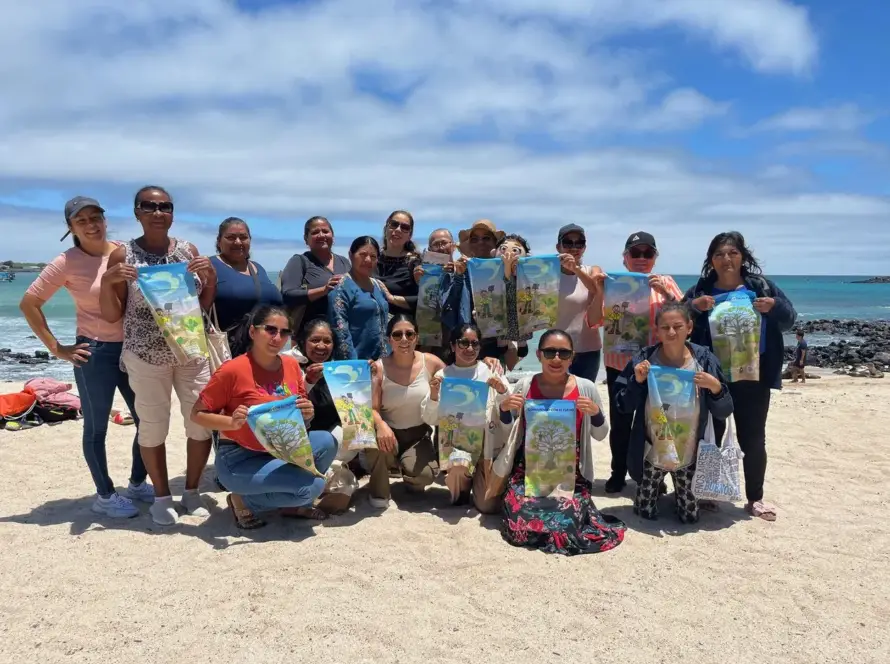
Conservation cannot succeed without gender equity. Women are disproportionately affected by environmental degradation — and they are disproportionately powerful agents of environmental change. This module explores the connection between gender, leadership, and the future of Galápagos.
What we learned
Women and natural resource management:
Globally, women manage more than 80% of household natural resource use. Their decisions directly shape local ecological footprints.
Gender barriers in conservation:
Women face structural obstacles to participating in environmental decision-making: time poverty due to caregiving responsibilities, limited access to technical training, and exclusion from governance spaces.
Leadership as conservation strategy:
Research consistently shows that communities with high female participation in natural resource governance achieve better conservation outcomes and more equitable benefit-sharing.
Multiplier effect:
Women who receive environmental education share it with their children, partners, and social networks, creating a ripple of behavior change that extends far beyond the individual participant.
What Science Says
A landmark study published in World Development (Agarwal, 2010) demonstrated that forests managed by groups with significant female membership showed better regeneration rates and lower levels of illegal extraction. The Blue Guardians model builds directly on this evidence base.
Reflect
In your family and community, who makes the decisions about how to use natural resources? How could women’s voices be heard more in these decisions?
Now Do It Yourself

Explore the community icons in 360°— in the virtual tours you will find points that showcase the life and culture of San Cristóbal, not just its nature.
Visit “What We Learned” — read about the Guardians’ learning process in their own words.
References
Bennett, N. J., Blythe, J., Cisneros-Montemayor, A. M., Singh, G. G., & Sumaila, U. R. (2019). Just transformations to sustainability. Sustainability, 11(14), 3881. https://doi.org/10.3390/su11143881
Comisión Económica para América Latina y el Caribe — CEPAL. (2021). Implicancias de los roles de género en la gobernanza de los recursos naturales en América Latina y el Caribe. https://cepal.org
IUCN. (2020). Género y conservación de la naturaleza en Latinoamérica y el Caribe. https://iucn.org
Leisher, C., Temsah, G., Booker, F., Day, M., Samberg, L., Prosnitz, D., & Sunderland, T. (2016). Does the gender composition of forest and fishery management groups affect resource governance and conservation outcomes? A systematic map. Environmental Evidence, 5(1), 6. https://doi.org/10.1186/s13750-016-0057-8
Naciones Unidas. (2015). Agenda 2030 para el Desarrollo Sostenible. Objetivo de Desarrollo Sostenible 5. https://sdgs.un.org
Programa de las Naciones Unidas para el Medio Ambiente — PNUMA. (2021). Género y medio ambiente — Acciones en América Latina y el Caribe. https://unep.org
Robalino, J. (2026). Taller de género y conservación. Universidad San Francisco de Quito — Proyecto Guardianas Azules.
ScienceDirect. (2024). Overcoming gender-related challenges and supporting women in conservation in Latin America. Biological Conservation. https://doi.org/10.1016/j.biocon.2024.110587
Westermann, O., Ashby, J., & Pretty, J. (2005). Gender and social capital: The importance of gender differences for the maturity and effectiveness of natural resource management groups. World Development, 33(11), 1783–1799. https://doi.org/10.1016/j.worlddev.2005.04.004
Ziritt, D. (2025). Talleres de empoderamiento emocional “Ser parte de algo grande”. Universidad San Francisco de Quito — Proyecto Guardianas Azules.