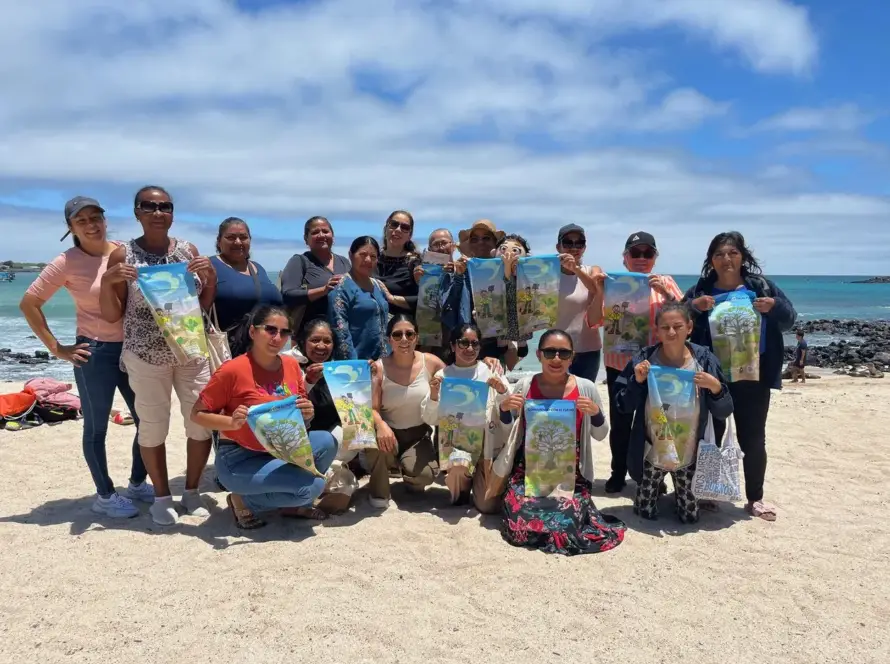
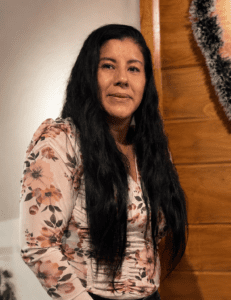
Elita, Guardiana Azul, San Cristóbal“The first time I put my face in the water with the snorkel, I couldn’t believe what I was seeing. It’s another world. One that had always been there and I had never seen.”

— Elita, Blue Guardian, San Cristóbal
Introduction

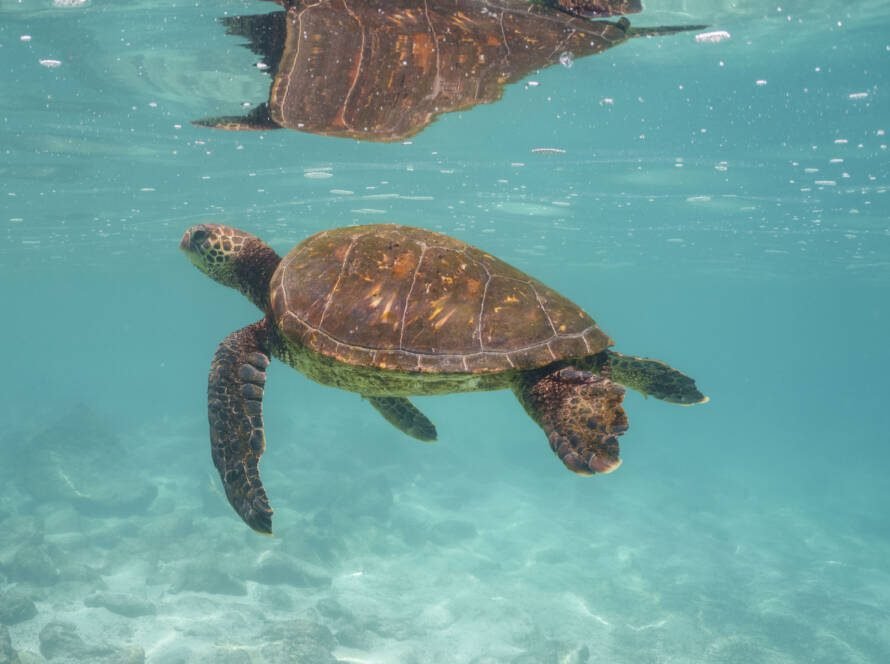
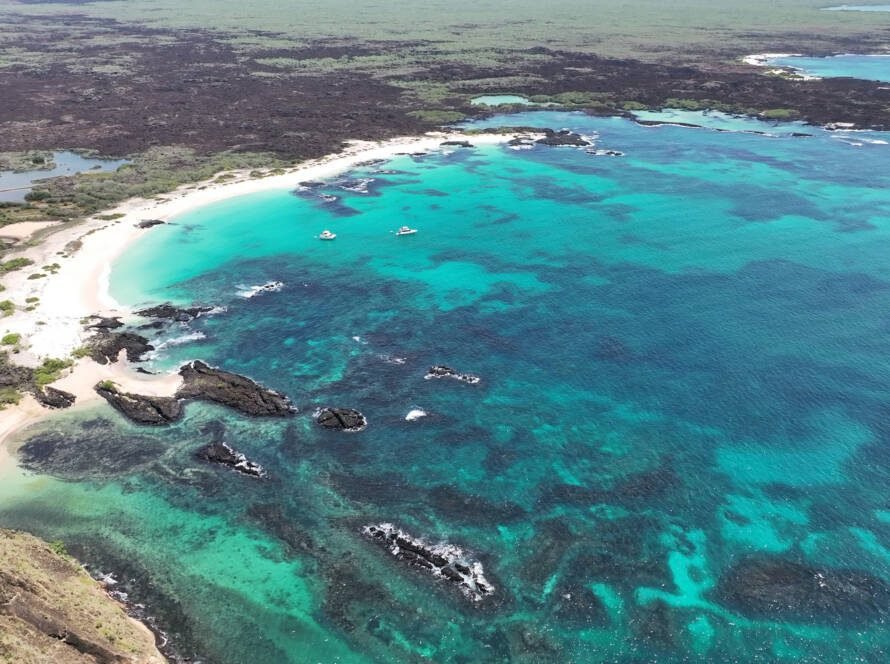
The waters surrounding San Cristóbal are not an empty blue backdrop — they are a universe filled with life, color, movement, and invisible connections that sustain the entire island ecosystem.

The Humboldt Current arrives cold from the south, the Panama Current brings warm waters from the north, and the Cromwell Current rises from the west in the deep sea. When these currents collide with the volcanic formations of the archipelago, they generate upwelling — deep, nutrient-rich water rises to the surface, feeding everything from plankton to whales. Nearly 20% of Galápagos marine life is endemic.

What we learned

Marine and coastal ecosystem:

The set of living beings, water, soil, and climate that interact in the zone where the sea and land meet. In Galápagos this includes beaches, rocky reefs, sandy seafloors, open waters, and mangroves.

Ocean currents and upwelling:

The Humboldt, Panama, and Cromwell currents meet in Galápagos, generating upwelling that carries nutrients from the depths to the surface.

Food chain:

The web of who eats whom in the ocean. It begins with phytoplankton and extends to large predators like the hammerhead shark or orca.

Mangroves:

Coastal ecosystems made up of trees that grow between saltwater and land. In Galápagos they serve as natural nurseries for fish and store enormous amounts of carbon.

Ecosystem services:

The benefits that nature provides freely: fish to eat, clean water, coastal protection, climate regulation, tourism. Galápagos mangroves store more than 778,000 tons of carbon.

Habitat:

The specific place where a species lives and finds everything it needs to survive.

What Science Says

The Galápagos mangroves are considered a unique natural laboratory in the world. Unlike the rest of Ecuador and the Eastern Pacific, where more than 40% of mangroves have disappeared in recent decades, those in Galápagos remain almost entirely intact. According to a study published in Ecological Economics, the total value of ecosystem services provided by Galápagos mangroves exceeds $22,000 per hectare per year (Tanner et al., 2019).

Reflect

What would happen to life in San Cristóbal if the ocean lost its nutrients? What would change in your daily life?

Now Do It Yourself

Explore La Lobería, Isla Lobos, and León Dormido in 360° — dive virtually into the habitats of San Cristóbal and look for the species icons in each scene.


Visit the Library — get to know the animal and plant species that make this island unique.

Download iNaturalist — the next time you see an animal or plant in Galápagos, record it. Your observation can contribute to science.

References

Denkinger, J., & Vinueza, L. (Eds.). (2017). The Galapagos Marine Reserve: A dynamic social-ecological system. Springer.

Fundación Charles Darwin. (2021). New study: Mangroves in Galapagos are key ecosystems to fish species. darwinfoundation.org

Fundación Charles Darwin. (2022). Fishers’ local ecological knowledge to support mangrove research in the Galapagos. Frontiers in Marine Science. https://doi.org/10.3389/fmars.2022.911109

Ministerio del Ambiente del Ecuador — MAE. (2014). Plan de manejo de la Reserva Marina de Galápagos.

Paltán, H., Chadwick, O., Kinnaird, M., Bhatt, U., & Jochum, M. (2021). Climate and sea surface trends in the Galapagos Islands. Scientific Reports, 11(1), 14871. https://doi.org/10.1038/s41598-021-93870-w

Tanner, M. K., Vázquez-Vera, L., Cabral-Tena, R. A., Serviere-Zaragoza, E., Hindell, M., & Bascompte, J. (2019). Mangroves in the Galapagos: Ecosystem services and their valuation. Ecological Economics, 160, 12–24. https://doi.org/10.1016/j.ecolecon.2019.01.024