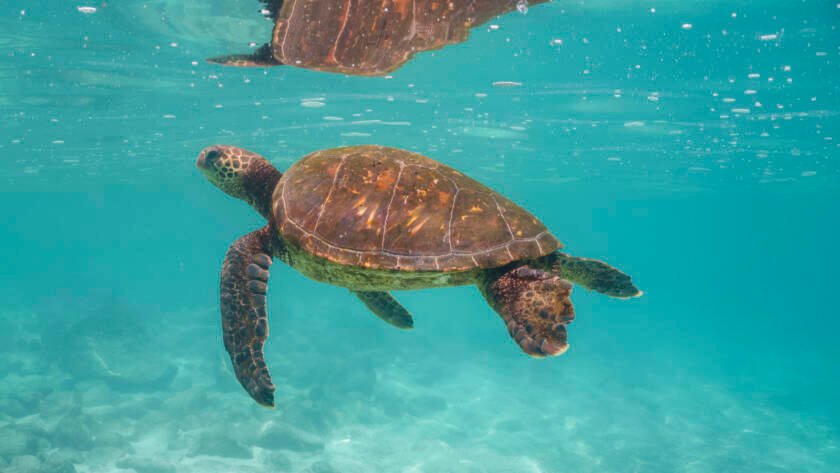


Chelonia mydas
One of the most migratory and long-lived reptiles in the world. Its common name does not refer to the color of its shell, but to the color of its body fat — stained green by the pigments of the algae it consumes.
Unlike other sea turtles, the green turtle is the only species whose diet changes dramatically with age — juveniles are omnivorous, while adults are strictly herbivorous.
The beak is blunt with serrated edges — an evolutionary adaptation perfectly suited for grazing and cropping seagrasses and marine algae.
Females possess a remarkable magnetic memory that guides them back to nest on the exact beach where they were born — even after decades of traveling thousands of kilometers across the ocean.
The sex of hatchlings is governed by sand temperature during incubation: warmer sand (above 29°C) produces predominantly females, while cooler sand produces predominantly males.