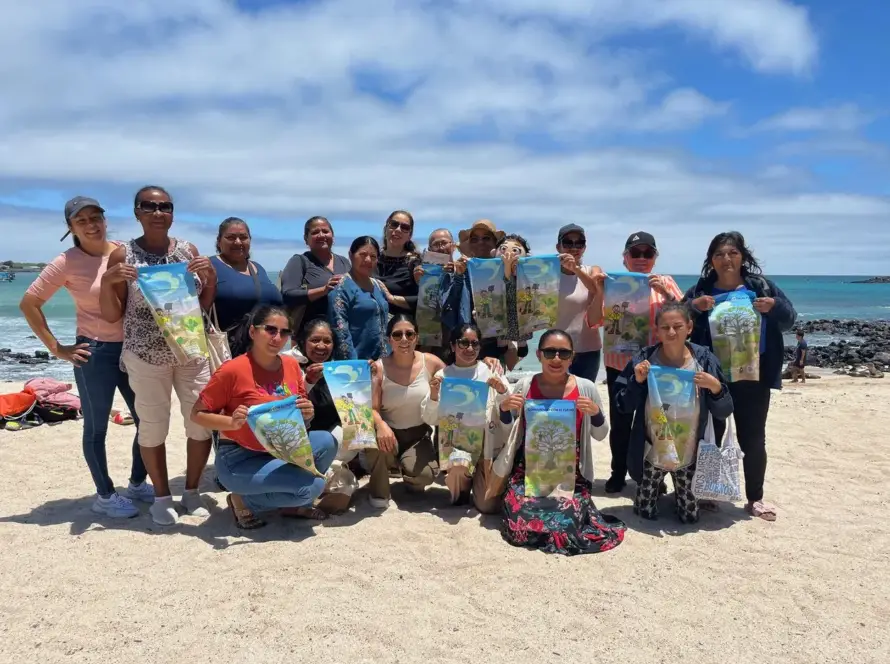
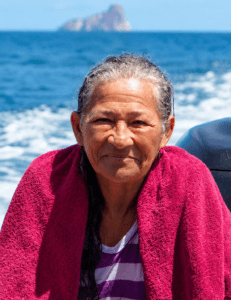
Cloris Díaz González, integrante del colectivo Guardianas Azules de San Cristóbal, Galápagos“I was born here, I walked these beaches my whole life, but I had never asked myself what was beneath the water. This project made me see my island with new eyes.”

— Cloris, Blue Guardian, San Cristóbal
Introduction

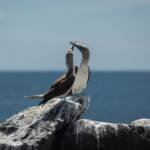
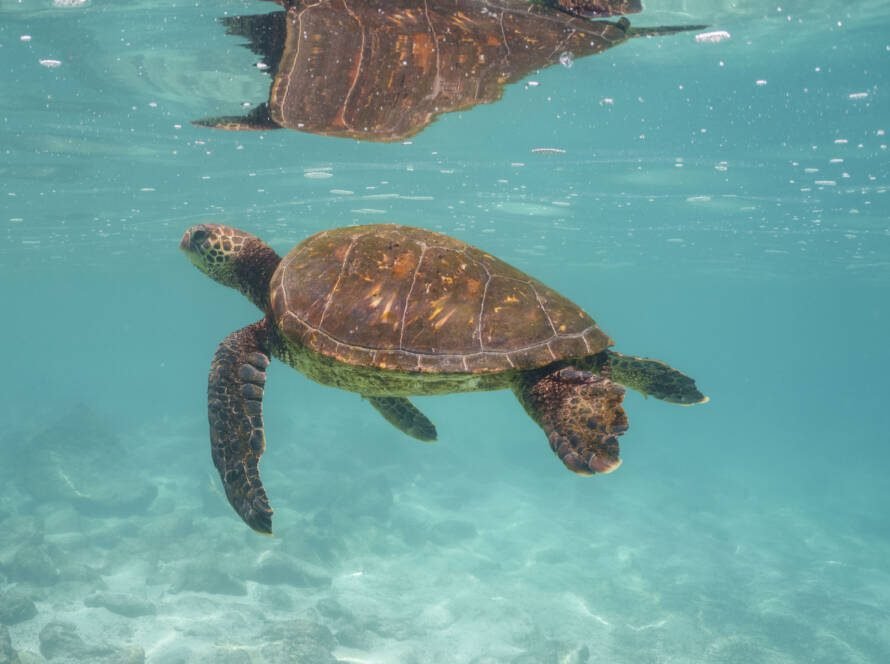
The Galápagos Islands form a volcanic archipelago located in the Pacific Ocean, about 1,000 kilometers from the continental coast of Ecuador. Declared a UNESCO Natural World Heritage Site, they are home to more than 7,000 species of native and endemic plants and animals, many of which exist nowhere else on the planet. 97% of their land surface is a National Park, and their waters are part of one of the most important marine reserves in the world.

San Cristóbal is the easternmost island in the archipelago and the capital of the island province. With approximately 7,475 inhabitants (INEC, 2022), it is home to a community whose life — its economy, its culture, its identity — is deeply connected to the sea.

What we learned

As part of the Blue Guardians project, the biodiversity workshop revealed something powerful: before the workshop, 81% of participants already recognized Galápagos as a special place, but only 31% could accurately define what biodiversity means.

Biodiversity:

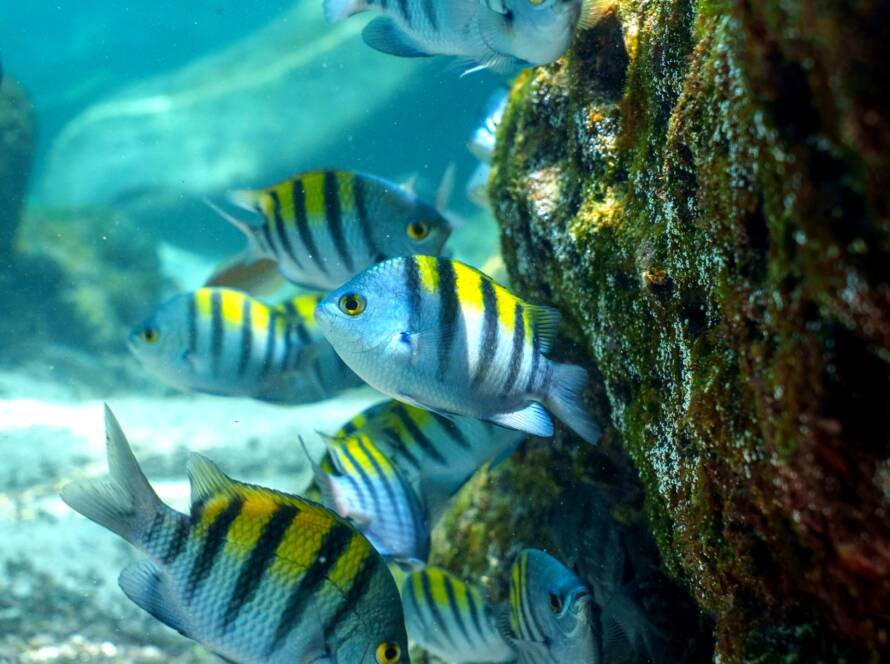
The variety of life forms that coexist in a place: animals, plants, fungi, microorganisms. Galápagos retains 95% of its original biodiversity.

Native species vs. endemic species:

A native species is one that exists naturally in Galápagos but can also be found elsewhere. An endemic species exists here and nowhere else in the world.

Biosphere Reserve:

A designation granted by UNESCO that recognizes Galápagos as a territory where nature conservation and sustainable human development coexist.

Protected areas:

Galápagos has three protection zones: the Galápagos National Park, the Galápagos Marine Reserve, and the Brotherhood Marine Reserve.

Citizen science:

Anyone can contribute to scientific knowledge. Apps like iNaturalist allow people to record species and contribute real data to conservation.

What Science Says

Galápagos is recognized worldwide as one of the most important natural laboratories on the planet. It was here that Charles Darwin developed the foundations of his theory of evolution by natural selection. A study published in Scientific Reports confirms that preserving 95% of the islands’ original biodiversity is one of the most extraordinary achievements in global conservation, and that the local community is an inseparable part of that success.

Reflect

What part of San Cristóbal — a place, an animal, a beach — do you feel is worth protecting? Why?

Now Do It Yourself

Explore the San Cristóbal Waterfront in 360° — take a virtual walk through the heart of the community and discover information points about local life and coastal biodiversity.

Visit the Library — get to know the animal and plant species that make this island unique.

Download iNaturalist — the next time you see an animal or plant in Galápagos, record it. Your observation can contribute to science.

References

Denkinger, J., & Vinueza, L. (Eds.). (2017). The Galapagos Marine Reserve: A dynamic social-ecological system. Springer.

Epler, B. (2007). Tourism, the economy, population growth, and conservation in Galapagos. Charles Darwin Foundation.

Fundación Charles Darwin. (2020). Guías didácticas de educación ambiental de Galápagos. ISBN: 978-9978-53-072-6

Fundación Charles Darwin. (2024). Impact Report 2024. darwinfoundation.org

Instituto Nacional de Estadística y Censos — INEC. (2022). VIII Censo de Población y VII de Vivienda. Resultados Galápagos. ecuadorencifras.gob.ec

Paltán, H., Chadwick, O., Kinnaird, M., Bhatt, U., & Jochum, M. (2021). Climate and sea surface trends in the Galapagos Islands. Scientific Reports, 11(1), 14871. https://doi.org/10.1038/s41598-021-93870-w

Parque Nacional Galápagos. (2024). Áreas protegidas de Galápagos. galapagos.gob.ec

Pazmiño, D. (2025). Informe final — Taller de biodiversidad. Universidad San Francisco de Quito — Proyecto Guardianas Azules.